Copying a software product. Legally. In a few hours.
Cursor recreated SQLite using an agent swarm, without source code. Automated clean room, model economics, and infra bottlenecks.
Copying an entire software product. Legally. In a few hours.
Cursor just proved it with SQLite.
There’s a lot of talk about agent swarms right now. The concept is simple: instead of one agent doing everything, you launch dozens in parallel, each with a specific role. Until now, it was mostly hype. Cursor’s article is a solid demonstration.
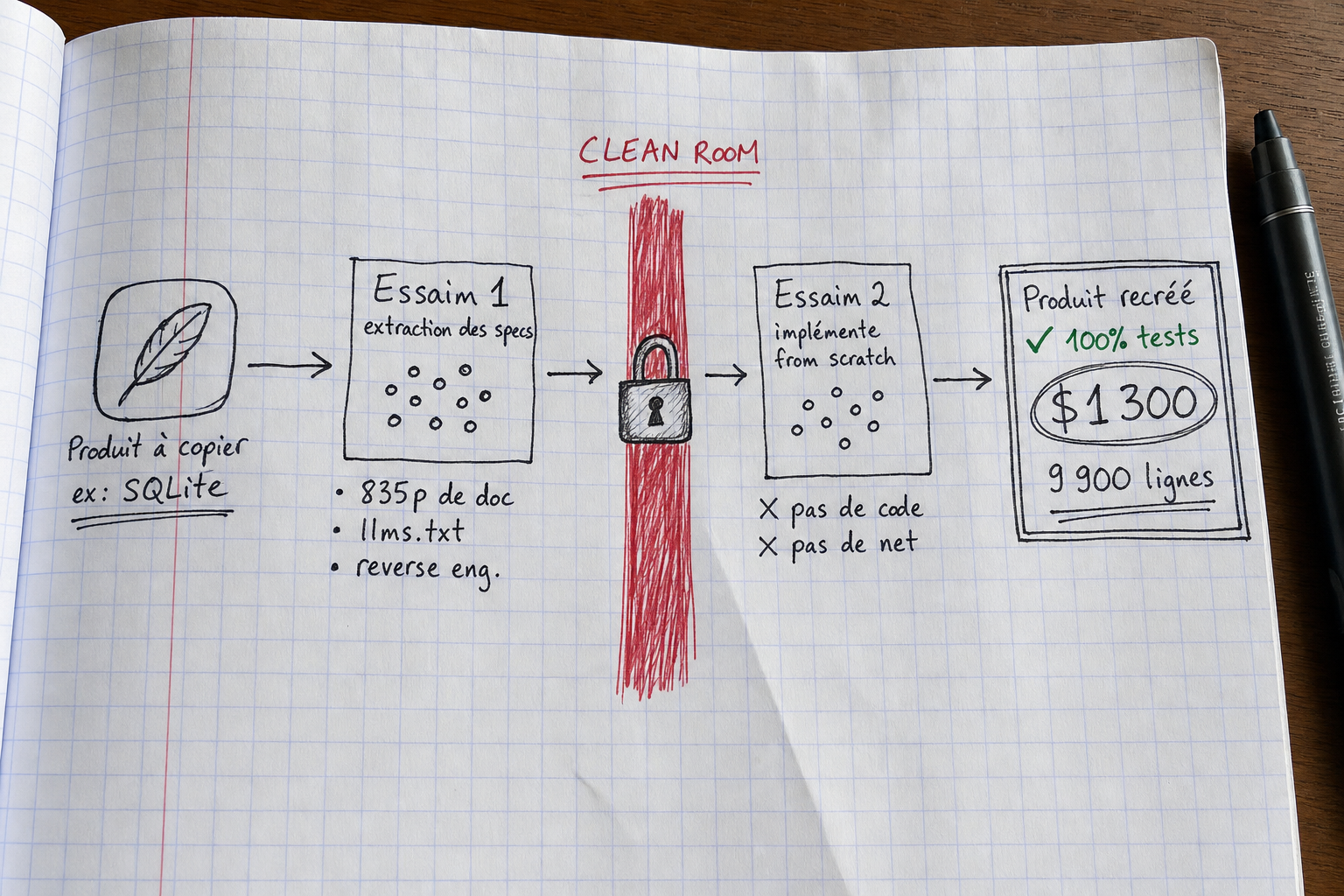
835 pages of SQLite documentation. No source code. No internet access. A swarm of agents that decomposes, implements, reviews and merges. Autonomously.
Result: 100% of conformance tests passed. In a few hours.
We’re not talking about a todo app. SQLite has been around for 25 years, it’s one of the most deployed pieces of software in the world, full of edge cases.
What this makes possible
The technique is called “clean room”. It’s been around since the 80s in hardware - that’s how IBM’s BIOS was cloned by Compaq. The principle:
A first team extracts the specifications of a product. A second team implements those specs. Without ever seeing the source code.
Zero intellectual property violation.
Here, SQLite’s documentation serves as the specification. Cursor proved that agents can implement a complete product from specs, without seeing the source code.
That’s half the clean room.
The other half, extracting the specs? You can launch a first swarm to create specs from scratch. Or, like 80% of today’s SaaS products, you can scrape all the product and technical documentation directly. That’s what I did with SuperWhisper: their llms.txt explains to LLMs how the app works and what the full functional scope is. In 30 minutes, Claude had absorbed 80% of the product’s value.
Put the two together and you have the complete clean room. Automated. For a fraction of the cost.
The cost
$1,300 to recreate SQLite with the right model mix. Versus $10,500 using the most expensive model everywhere. Same final quality.
The bottleneck nobody anticipates
Infrastructure.
1,000 commits per second. Git explodes. Merge queues, locks, nothing holds up. Cursor had to build their own version control system from scratch.
Tools designed for devs who commit 5 times a day don’t work when agents commit 1,000 times per second.
“Yeah but the moat isn’t code anymore, we’ve known that for 2 years.”
Yes, we say it. But now we’re going from talk to proof. SQLite recreated identically, for $1,300, in a few hours.
The stance
What interests me most in all of this is the stance.
I see two camps among developers today. Those who keep repeating “a dev isn’t just someone who writes code, AI won’t replace us”. And those who completely switch off their brain and let the agent do everything.
I see far fewer people taking the third path: building the systems that build the systems.
That’s exactly what Cursor is doing here. And that’s exactly what engineers did during the industrial revolution. They didn’t keep making parts by hand. They built the factories.
Who else but developers to do this?
Agent swarms are a solid pattern to add to your toolkit.
Honest disclaimer: SQLite has exhaustive documentation and it’s open source. For a closed SaaS with years of undocumented edge cases, it’s a different story. But the cost of reimplementation just collapsed, and the trend only goes one way.